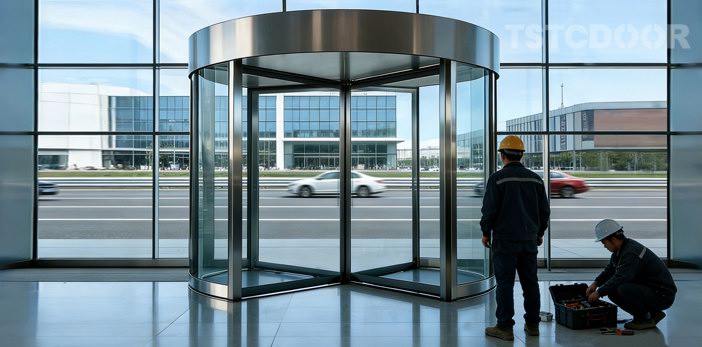
Stainless steel sheet is a common material in our daily life and work. For automatic doors, it is widely used for surface cladding of door bodies, which could enhances the high-end appearance of revolving doors, sliding doors, swing doors and other types of automatic doors, what’s more, they could also deliver excellent properties such as corrosion resistance and fingerprint resistance. Therefore, stainless steel sheets are highly popular in the automatic door industry.
1. Common Thickness Classification
Stainless steel sheets are generally divided into thin sheets (0.2–3 mm), medium sheets (3–20 mm) and thick sheets (over 20 mm). Featuring corrosion resistance, high structural strength, easy cleaning and decorative aesthetics, they are widely used. The mainstream grades include 304/304L, 316L, 201, 430 and 2205, tailored for architectural decoration, food processing, chemical industry and heavy-duty engineering scenarios.
1-1. Conventional Thickness Specifications
•Thin Sheets (Cold Rolled)
Common sizes: 0.2, 0.3, 0.4, 0.5, 0.6, 0.8, 1.0, 1.2, 1.5, 2.0, 2.5, 3.0 mmSurface finishes: 2B matte, BA bright, No.4 brushed, mirror finish
Medium Sheets (Cold & Hot Rolled)
Common sizes: 3, 4, 5, 6, 8, 10, 12, 14, 16, 18, 20 mmSurface finishes: 2B, No.1 hot-rolled pickled finish
•Thick Sheets (Hot Rolled)
Common sizes: 20, 25, 30, 40, 50, 60, 80, 100 mm and aboveSurface finishes: No.1, sandblasted, custom polished .
1-2. Standard Panel Dimensions
1000×2000 mm, 1220×2440 mm, 1500×3000 mm, 1500×6000 mm (universal specifications).
2. Characteristics of Mainstream Stainless Steel Grades
No.304 . Universal austenitic stainless steel with excellent overall corrosion resistance, good toughness and workability, and cost-effective performance. Resistant to atmospheric erosion and weak acid environments, suitable for food-grade applications.Limitations: Poor resistance to chloride corrosion and high-temperature sensitization.
No. 316L . Low-carbon molybdenum-bearing austenitic stainless steel. Offers superior corrosion resistance, high-temperature stability and excellent weldability. The added molybdenum element significantly improves resistance to pitting and crevice corrosion.Ideal for coastal, marine, chemical, pharmaceutical and sanitary equipment.
No. 201 . Low-nickel high-manganese stainless steel with low cost and high mechanical strength.Limitations: Inferior corrosion resistance; prone to rust in humid or outdoor environments, only for dry indoor use.
No. 430 . Ferritic magnetic stainless steel with outstanding heat resistance and polishing performance at a lower cost.Limitations: Weak acid and alkali resistance, mainly used for household appliances and interior decoration.
No. 2205 . Duplex stainless steel combining austenite and ferrite structures. Features ultra-high strength, excellent chloride corrosion resistance and fatigue resistance, with double the mechanical strength of 304.Applied in pressure vessels, marine engineering and harsh chemical working conditions.
3. Thickness Performance & Application Scenarios
•Thin Sheets (0.2–3.0 mm)
Flexible, delicate surface, easy to bend and form .
0.2–0.6 mm: Signage, electronic components, architectural decorative materials .
0.8–1.0 mm: Kitchen sinks, home appliance panels, automatic door & elevator accessories .
1.2–1.5 mm: Elevator cabins, exterior wall cladding, door frames, handrails .
2.0–3.0 mm: Kitchen countertops, storage racks, equipment enclosures .
• Medium Sheets (3–20 mm)
Balanced strength and processability, the most widely used specification.
3–6 mm: Mechanical frames, stair treads, curtain wall keels .
8–12 mm: Storage tanks, railing systems, industrial mechanical components .
14–20 mm: Structural supports, heavy machinery parts, pressure vessel plates .
•Thick Sheets (Over 20 mm)
High rigidity, impact resistance and load-bearing capacity.
20–50 mm: Marine components, port machinery, heavy structural parts .
50 mm and above: Large pressure vessels, special engineering and heavy-duty equipment .
4. Industry Application Recommendations
• Architectural Decoration
Curtain wall & exterior wall: 0.6–1.5 mm (304/316L, brushed/2B finish) .
Elevator decoration: 1.2–2.0 mm (304, mirror/brushed finish) .
Handrails & railings: 1.5–2.5 mm (304/316L) .
• Food & Pharmaceutical Industry
Sanitary equipment and tanks: 1.0–10 mm (food-grade 304/316L) .
Chemical & Environmental Protection .
General medium: 6–16 mm 304 .
Chloride & acid-base environment: 6–20 mm 316L/2205 .
• Kitchen & Household Appliances
Sinks & countertops: 0.8–1.2 mm 304 .
Home appliance liners: 0.4–0.8 mm 430/304 .
5. Summary
Thin Stainless Steel Sheets: Lightweight & decorative, for home furnishing and architectural decoration.
Medium Stainless Steel Sheets: Versatile & cost-effective, the preferred choice for industrial and construction projects.
Thick Stainless Steel Sheets: High strength & durability, for heavy-duty and special engineering fields.


