All-glass revolving door -TAR600 from TSTC Automatic Doors adopt underground /bottom driving mode, that means the motor, gearbox, control unit and main load‑bearing bearing are all installed under the ground.
Different from the top‑driving revolving doors, the complete drive set and load‑bearing assembly are assembled in the top canopy, door wings are revolving together with the main shaft which connected to the driving system .

1. Lower requirements for building structure and ceiling conditions
▪ No heavy‑duty top load‑bearing steel beam required. For top‑driven units, the full door weight plus dynamic impact loads are borne by the overhead steel structure, so a dedicated load‑bearing beam must be reserved in the building. With bottom‑driven designs, all loads are transferred to the concrete floor, the ceiling serves only decorative purposes and bears no door weight. This makes them highly suitable for renovation projects of existing buildings and sites with dense overhead services such as air ducts, fire‑protection pipes and cable trays above the ceiling.
▪ Reduced headroom requirement for ceiling access. Top‑driven canopies accommodate motors, slip rings and reduction assemblies, requiring minimum 300‑600 mm maintenance clearance above the ceiling. Bottom‑driven systems feature purely decorative top canopies with much lower overhead clearance demand, and can be applied in lobbies with low ceiling heights.
▪ Insensitive to minor building settlement or slight ceiling deformation. Top‑driven doors are vulnerable to such deviations, which may cause rubbing, abnormal noise or jamming.
2. Better mechanical stability and wind‑pressure resistance
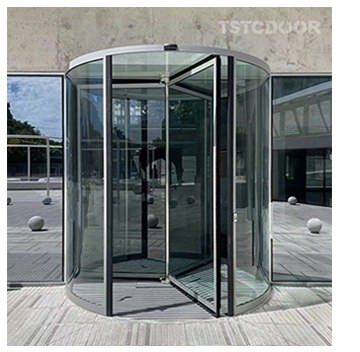
▪ Low centre of gravity for smoother operation. Drive and main bearing are located at floor level, keeping the door’s centre of gravity close to the supporting point. Top‑driven doors adopt a cantilever suspension structure with free‑hanging lower leaf ends. Under strong wind pressure, leaf deflection and swing increase, which may trigger undesired safety‑sensor shutdowns, rattling and noise.
▪ Superior resistance to lateral wind. In windy northern regions or coastal typhoon‑prone areas, door‑leaf vibration amplitude remains low. Sealing gaskets maintain better contact, reducing air infiltration and energy loss.
▪ The bottom‑mounted bearing works under pure compressive load with rational force distribution. Top‑mounted bearings endure large overturning moments, alternating cyclic loads accelerate wear and play over service time.
3. Higher convenience for maintenance and servicing
▪ Drive components sit at floor level, no ceiling dismantling for servicing. For bottom‑driven doors, motors, reducers, encoders and main bearings are accessible by opening the floor access cover. Servicing top‑driven units demands canopy and ceiling removal plus working at height, resulting in significantly higher man‑hours and maintenance costs.
▪ Lower slip‑ring failure risk. Top‑driven doors require high‑power overhead rotating slip rings to supply power to leaf‑mounted sensors and light strips, slip rings are high‑wear consumable parts. Most bottom‑driven configurations reduce slip‑ring loading or even simplify this assembly, minimizing poor contact and signal‑interruption faults.
▪ Fault diagnosis is straightforward without overhead inspection for noise measurement or troubleshooting.
4. Service life and long‑term reliability
▪ Compressive‑loaded bottom bearings allow easier lubrication retention. Suspended top bearings suffer overturning forces, temperature variation and vibration readily create clearances, leading to leaf sagging and rubbing against fixed frames after several years of operation.
▪ Electrical assemblies avoid high‑temperature conditions inside ceiling voids. Solar‑heat‑induced high overhead temperatures accelerate ageing of motors, frequency converters and circuit boards. The floor‑mounted base of bottom‑driven doors operates under more stable ambient temperatures (proper base waterproofing is mandatory).
5. Comparison Table Between Underground & Top Driving Mode
|
Comparison Items |
Underground Driving Mode |
Top-Driving Mode |
|
Building Structure Requirement |
No ceiling load-bearing beam required, all loads borne by floor concrete. Low ceiling height adaptability, suitable for renovation projects. |
Dedicated overhead load-bearing steel beam mandatory, high ceiling clearance required. Inapplicable for lobbies with dense overhead pipelines. |
|
Operation Stability & Wind Resistance |
Low center of gravity, stable operation. Resists lateral wind effectively, less door leaf swing and air leakage. Bearing bears reasonable compressive load. |
Cantilever suspension structure. Prone to leaf swing & deflection under wind load, causing noise and accidental shutdown. Bearing suffers overturning moment. |
|
Maintenance & Service |
All drive components at floor level, easy access without ceiling dismantling. Low slip ring failure rate, low long-term maintenance cost. |
High-altitude maintenance required with ceiling/canopy disassembly. High slip ring wear, complex troubleshooting and high labor cost. |
|
Service Life & Reliability |
Stable bearing stress, durable lubrication. Electrical parts avoid high ceiling ambient temperature, low aging rate. |
Easy to generate structural clearance after long-term use, causing leaf sagging and frame rubbing. Electrical components age faster in high-temperature ceiling voids. |
|
Installation & Commissioning |
No overhead steel beam welding, simple floor foundation construction, convenient ground-level debugging. |
Complicated overhead construction and high-altitude gap calibration, long installation & commissioning cycle. |
|
Defects & Limitations |
Requires reinforced floor foundation and strict base waterproofing, visible floor access cover. |
Perfect floor decoration with no ground damage or water flooding risk. |
|
Applicable Scenarios |
Old building renovation, low ceiling, complex overhead pipelines, windy & coastal areas, cost-effective long-term operation. |
New buildings with finished floors, high aesthetic requirements for integrated ground decoration. |


