To the hospital ward doors also called swing hermetic doors, the popular types of key materials including the galvanized steel, aluminum alloy, HPL, stainless steel and wood. The details will be showed as below .
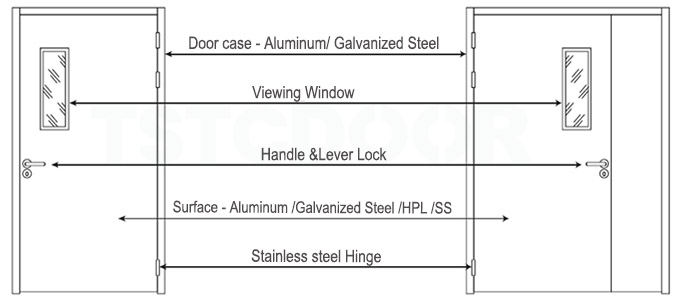
1. Hot-Dip Galvanized Steel Medical Doors
▪ Structure
Door leaf: 0.8–1.0 mm hot-dip galvanized steel sheet with jointed seamless folding / integrated bending, inner core filled with paper honeycomb, aluminum honeycomb or sound-insulating rock wool.
Door case: 1.2–1.5 mm galvanized steel sheet with antibacterial electrostatic powder coating, wood grain transfer printing or film lamination finish.
▪ Advantages
Best cost performance, top choice for mass hospital construction projects.
Galvanized coating provides rust resistance, tolerates long-term wiping with 84 disinfectant, alcohol and chlorine-containing disinfectants.
High structural strength, resistant to impacts from hospital beds and trolleys, available as Class A fire-rated door.
Moderate overall weight for effortless manual swing operation, maintains shape after hundreds of thousands of opening & closing cycles.
Rich color options, wood grain transfer finish delivers warm texture similar to solid wood doors.
▪ Disadvantages
Cold metallic appearance, extra thick sound insulation wool is required to improve acoustic performance.
Prone to dents under heavy impact from sharp hard objects.
2. Electrolytic Galvanized Steel Doors
▪ Structure
Base material: 1.0–1.5 mm electrolytic steel sheet with dense native passivation layer, antibacterial spray coating applied, seamless integrated door leaf available, filled with aluminum honeycomb or rock wool core.
▪ Advantages
Far superior rust resistance compared to ordinary galvanized steel, no rust formation in high-humidity environments with frequent disinfection.
Ultra-flat surface with minimal gaps, no dust accumulation dead corners, complying with high hospital infection control standards.
Antibacterial and acid & alkali resistant, standard configuration for ICUs, isolation wards and fever clinics.
Fireproof, impact-resistant with service life over 15 years.
▪ Disadvantages
Cost is 30%–60% higher than hot-dip galvanized steel doors.
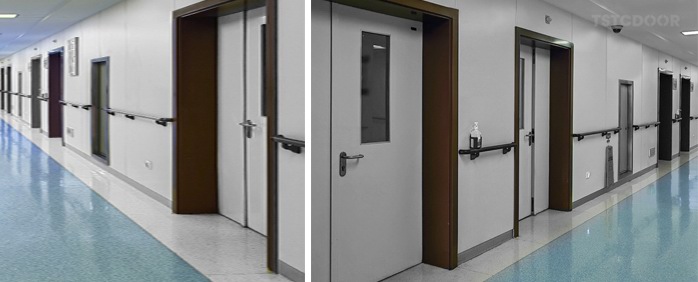
3. Aluminum Ward Doors (Door leaf panels and door cases are all aluminum)
▪ Structure
Face panel: 3003 anti-rust aluminum sheet / 5052 aluminum alloy sheet, standard thickness 1.2–1.5 mm.
Door Case & extruded profiles: 6063-T5 extruded aluminum alloy profiles.
Inner filling: Aluminum honeycomb core (lightweight and flame retardant).
Surface finish: Antibacterial polyester electrostatic powder coating, identical to the coating process of galvanized steel doors. Available in unified hospital RAL colors including light grey, off-white, light blue, as well as wood grain transfer finish.
▪ Advantages (Compared with Powder Coated Galvanized Steel Doors)
Zero rust risk: Top choice for coastal hospitals, dialysis rooms, wards adjacent to restrooms, and high-humidity fever clinics. Galvanized steel will rust once the coating is chipped to expose the base metal, while aluminum panels never corrode.
Light weight for effortless operation: Aluminum doors are 40% lighter than steel doors of the same dimension. The manual swing action is smooth, hinges are less prone to sagging, reducing wear and tear of hardware fittings.
Superior resistance to disinfectant corrosion: Aluminum base material boasts better chemical stability than steel. Long-term wiping with 84 disinfectant and chlorine-based disinfectants will not erode the substrate.
Non-magnetic and anti-static, suitable for laboratories and wards around radiology departments.
Integrated seamless bending structure with rounded R corners, no dust accumulation dead corners, meeting high hospital infection control standards.
▪ Disadvantages
Inferior impact resistance to galvanized steel: Aluminum is relatively soft and prone to dents under heavy impact from metal hospital trolleys, not recommended for standard multi-patient wards.
Higher cost: 40%~80% more expensive than DC51D+Z powder coated galvanized steel doors of identical specifications.
Limited fire resistance performance: Class A fire rating is hard to achieve, most products only reach Class B1 flame retardant grade.
Dents caused by sharp hard impacts cannot be repaired.
4. HPL High-Pressure Antibacterial Fire-Rated Panel Doors
▪ Structure
Moisture-proof high-density board substrate, both sides hot-pressed with high-pressure antibacterial HPL fire-resistant panels (commonly known as compact laminate medical boards) with seamless edge sealing treatment.
▪ Advantages
Surface hardness up to 6H, exceptional wear and scratch resistance, no permanent marks from repeated friction of hospital beds and wheelchairs.
99.9% antibacterial rate, dense non-porous surface for easy one-wipe cleaning.
Diverse patterns including soft wood grain and solid colors to create a cozy ward environment.
Class B1 fire resistance grade with better sound insulation than standard steel doors.
▪ Disadvantages
Relatively high price, not recommended for damp basements, edges prone to chipping under heavy sharp impacts.
5. Polymer Resin / Integral Medical PVC Doors (Bestseller for Humid Departments)
▪ Structure
Integral molded modified resin or composite thick PVC sheet, seamless door leaf filled with aluminum honeycomb core without splicing gaps.
▪ Advantages
Extremely low water absorption, fully waterproof and moisture-proof, ideal for restrooms and dialysis rooms.
Fully seamless construction eliminates dirt-trapping gaps, achieving full disinfection coverage.
Lightweight design for ultra-labor-saving silent manual sliding/swinging.
Resistant to corrosion by all types of chemical disinfectants.
▪ Disadvantages
Relatively low surface hardness, easily scratched by sharp edges of metal trolleys, inferior impact resistance to steel doors.
6. Engineered Wood Composite Medical Doors
▪ Structure
Multi-layer engineered wood composite substrate sealed with eco-friendly antibacterial water-based paint, inner core filled with sound-insulating & fire-resistant material with full sealed moisture-proof treatment.
▪ Advantages
Warm visual and tactile texture to reduce patients’ depressive feelings, best-in-class sound insulation performance.
Soft styling suitable for psychological departments, elderly rehabilitation and high-end private wards.
▪ Disadvantages
Inferior moisture resistance to metal and resin materials with high overall cost.
Paint layer tends to age after long-term intensive disinfection, leading to high maintenance costs, only Class B fire rating available.
Application
Single VIP wards, rehabilitation centers, psychological counseling rooms and high-end maternity zones.
7. 304 Stainless Steel Doors (Niche for Special Wards)
▪ Advantages
Maximum rust resistance, superior heavy corrosion resistance, anti-vandal performance and top-tier antibacterial property.
▪ Disadvantages
High cost, cold metallic texture and loud operating noise.
Note:
To the TSTC hospital ward doors, the thickness of the key materials will be showed as below .
1. Galvanized Steel. The door leaf is galvanized steel plate with thickness 0.8-1mm, the door case is galvanized steel plate with thickness 1.5mm .
2. Aluminum . The door leaf is aluminum plate with thickness 1.2-1.6mm, the door case is aluminum alloy with thickness 4mm .
3. HPL Plate . The door leaf is HPL plate with thickness 1mm +1mm aluminum plate inside.
4. Stainles Steel. The door leaf is stainless steel plate with thickness 1.2mm, the door case is aluminum alloy with thickness ≥1.5mm inside + 1.2mm stainless steel .
The grade of the key materials will be showed as below .
1. Aluminum. For door leaf : 3003 anti-rust aluminum /5052 aluminum alloy, standard thickness 1.2–1.6 mm. For door case & extruded profiles: 6063-T5, the thickness is 4mm .
2. Galvanized Steel. DC51D+Z (SGCC), thickness for door leaf is 0.8-1mm, thickness for door case is 1.5mm .
3. Stainless Steel . 304 for standard. 1.2mm for door leaf, 1.2mm for door case (with 1.5mm aluminum inside) .


