There are mainly 3 types of motors for automatic revolving doors like TAR200, TAR300, TAR600 from TSTC Automatic Doors, they are Brushed Motor, Brushless DC Motor(BLDC) and Permanent Magnet Synchronous Motor(PMSM) . Their advantages and disadvantages will be showed as below .
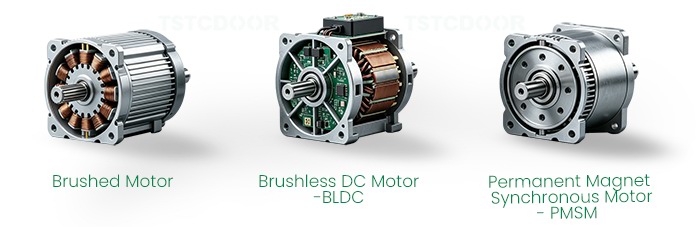
1. Brushed Motor
1-1 Advantages
▪ Simple structure and low cost; compatible with universal controllers.
▪ Easy control logic, sufficient low-speed torque and simple commissioning.
▪ Widely available spare parts and easy maintenance.
1-2 Disadvantages
▪ Prone to carbon brush wear, short service life and regular replacement required.
▪ High operating noise and strong electromagnetic interference.
▪ Low energy efficiency and high heat generation; poor performance for long-duration continuous operation.
2. Brushless DC Motor(BLDC)
2-1 Advantages
▪ No carbon brush wear, long service life and nearly maintenance-free.
▪ Higher energy efficiency, low heat generation, stable operation and low noise.
▪ Weak electromagnetic interference and high operational reliability.
▪ High overall cost performance, the mainstream choice for commercial automatic doors.
2-2 Disadvantages
▪ Requires dedicated drive controller, higher total cost than brushed motors.
▪ Complex control system, requiring professional skills for repair and commissioning.
▪ Inferior low-speed performance and dynamic response compared with permanent magnet synchronous motors.
3. Permanent Magnet Synchronous Motor (PMSM)
3-1 Advantages
▪ Top-level energy efficiency with outstanding power-saving performance.
▪ High torque at low speed, smooth start & stop and ultra-low noise.
▪ High power density and compact size; support direct drive design without gearbox.
▪ High control precision and fast response, ideal for high-end intelligent equipment.
▪ Minimal mechanical loss and excellent durability.
3-2 Disadvantages
▪ Highest total cost for motor and supporting servo system.
▪ Complicated control algorithms with high requirements for electronic control technology.
▪ Risk of demagnetization and slight performance degradation under high temperature.
▪ Poor versatility of spare parts and difficult maintenance.
4. Selection Guide
▪ Low-end basic doors: Brushed motor .
▪ Mid-range commercial revolving doors: BLDC motor .
▪ High-end buildings & landmarks: PMSM motor .


