Hygienic doors are specially designed for medical and other high-cleanliness environments. Featuring antibacterial property, airtight performance, easy cleaning and impact resistance, they mainly serve to control cross infection, maintain pressure difference and cleanliness, and ensure safe passage. Details on door types, structure, technical features and application scenarios are introduced as follows.
1. Main Door Types (Classified by Opening Mode & Function)
▪ Swing Door (Manual / Automatic, TWD100 -TSTC) . Most commonly used in wards and consulting rooms, available in single or double leaf with observation window. Manual version equipped with silent door closer, automatic version adopts sensor or foot control activation.
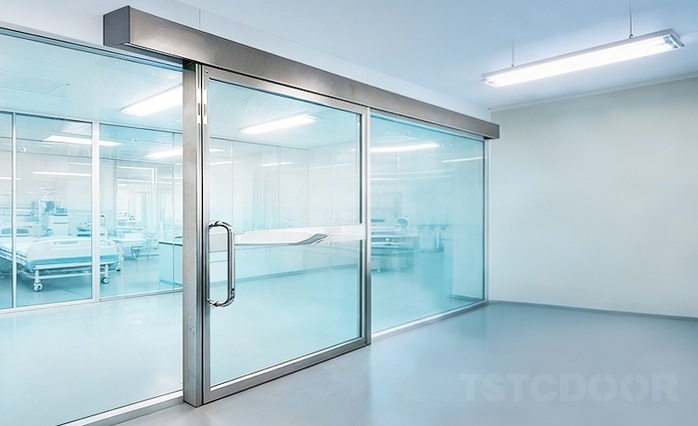
▪ Automatic Airtight Sliding Door (Exclusive for Operating Room & ICU , TH100 -TSTC). Electric suspended or rail-mounted design. High airtightness with contact-free infrared and foot activation, fitted with large-size clean viewing window.
▪ Radiation-proof Lead Door (Exclusive for Radiology Department, TH100L-TSTC). Available in swing, sliding and folding styles. Lined with 1–3mm lead plate to shield X-ray and gamma ray, matched with dedicated radiation-proof locks.
▪ Clean Room Door (For Laboratory & Sterile Area, TH100 -TSTC) .Made of full stainless steel or FRP material. Seamless integrated molding leaves no sanitary dead corners and facilitates disinfection, equipped with lifting sealing strips.
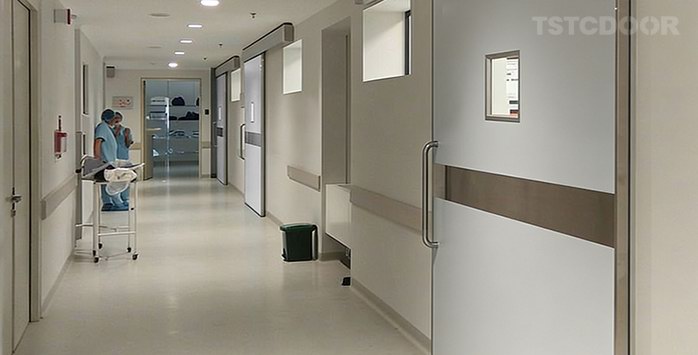
▪ Folding Door (For Big Openings & Equipment Rooms, TAF100S -TSTC) .Multi-leaf folding design occupies minimal space after full opening, ideal for areas with frequent large equipment transportation.
2. Structural Design (Focus on Antibiosis, Sealing & Durability)
2-1. Door Leaf (Thickness: 40–55mm)
▪ Panel: 0.8–1.0mm galvanized steel sheet, 304 stainless steel or FRP with silver-ion antibacterial coating.
▪ Inner filling: Aluminum honeycomb, high-density honeycomb paper or polyurethane foam for sound insulation, thermal insulation and impact resistance.
▪ Edge: 150mm high 304 stainless steel anti-collision strip against hospital bed impact.
▪ Window: 5 to 10 mm tempered or clean glass with rounded corner and seamless design.
2-2. Door Frame
▪ Material: 1.5–2.0mm galvanized steel sheet or stainless steel, single/double wrapping edge with buckle structure and concealed screws.
▪ Sealing: EPDM rubber strips for four-side sealing. Automatic doors adopt lifting bottom sealing strip to achieve full airtight closure.
2-3. Hardware Accessories (Full 304 Stainless Steel)
▪ Hinge: Silent butt hinge with strong load capacity and rust resistance.
▪ Lock: Medical split lock and antibacterial handle with antibacterial treatment on frequently touched parts.
▪ Door closer: Hydraulic silent type for buffered closing and noise reduction.
▪ Automatic door operator: Dual infrared and foot induction mode, equipped with anti-pinch and emergency release functions.
3. Core Technical Features (Six-level Medical Protection)
3-1. Antibiosis & Mildew Prevention (Key for Nosocomial Infection Control)
▪ Surface coated with over 45μm silver-ion antibacterial layer, inhibiting escherichia coli, staphylococcus aureus and other bacteria with antibacterial rate above 99%.
▪ Seamless structure without grooves resists high-strength disinfectants including alcohol and chlorine-based agents, free from corrosion after repeated wiping.
3-2. High Airtightness (Cleanliness Guarantee)
▪ Airtightness grade reaches level 6 and above, sustaining positive and negative pressure in operating rooms and ICU, blocking microbes, dust and peculiar smell.
▪ Combined bottom lifting seal and peripheral airbag seal comply with ISO 14644 clean standards.
3-3. High Durability & Impact Resistance (Suitable for Frequent Use)
▪ Impact strength twice higher than ordinary doors, capable of bearing impact force over 100kg to withstand long-term collision from beds and wheelchairs.
▪ Service life reaches 500,000 to 800,000 opening cycles with rust-proof hardware and stable structure.
3-4. Smart Contact-free Operation (Cross Infection Reduction)
▪ Activated by infrared/microwave sensors, foot switches and hand sensors without physical touch.
▪ Infrared light curtain and pressure sensor realize instant rebound within 0.5 seconds when obstacles detected.
▪ Auto unlocking and rapid escape function work in case of fire, compatible with fire control system.
3-5 Sound Insulation & Fire Resistance (Environmental Safety)
▪ Sound insulation performance: 40–45dB(A) creating quiet environment for wards and clinics.
▪ B1 grade flame retardant property, steel doors offer over 30-minute fire resistance.
3-6. Radiation Protection (Special Areas)
▪ Inner lead plate with lead equivalent of 1–3mmpb shields radiation in CT, DR and X-ray rooms.
4. Application Scenarios (Classified by Cleanliness & Function)
4-1. High-grade Sterile Zones (Strictest Standard)
▪ Operating rooms, ICU, laminar flow wards, sterile laboratories, BSL-3/4 biosafety laboratories.
▪ Core requirements: Airtightness, antibiosis, contact-free access, pressure regulation.
4-2. General Medical Zones (High-frequency Usage)
▪ Wards, consulting rooms, nurse stations, corridors, pharmacies, treatment rooms.
▪ Core requirements: Durability, impact resistance, low noise, easy cleaning.
4-3. Radiation Shielding Zones (Special Function)
▪ CT rooms, DR rooms, X-ray rooms, radiotherapy and nuclear medicine departments.
▪ Core requirements: Lead shielding, leakage prevention, dedicated hardware.
4-4. Auxiliary Clean Zones (GMP & Scientific Research)
▪ Pharmaceutical clean workshops, food sterile workshops, laboratories, animal houses.
▪ Core requirements: Seamless surface, antibiosis, chemical resistance, airtightness.


